Pest Proof Your Backyard in 10 Steps

A backyard to be serviced in Bristol TN - Leo's Pest Control

The sunshine and warmth bring everyone outdoors all spring and summer here in Bristol TN. However, we aren’t the only ones excited about the good weather. All sorts of common pests capitalize on the warmth that follows after a rainy season, and if we aren’t careful, our lack of preparation can invite them into our yards to settle, feed, and reproduce. Looking to learn how to keep pests out of your backyard? Read on for advice from the technicians at Leo’s Pest Control!

10 Pest-Proofing Tips for Your Backyard

Keeping pests out of your backyard during the spring and summer means adding pest prevention measures to your regular cleaning and upkeep routines. Here are our technicians’ 10 best tips to help you do so!

  1. Get rid of standing water: Still water provides breeding grounds for mosquitoes and a hydration source for many other kinds of pests. If you find rainwater pooling in buckets, planters, gutters, or elsewhere on your property, pour it out or cover it.
  2. Trim your plants: Unkempt trees, bushes, and brush can create shaded hiding places for pests like mosquitoes, ticks, and fleas.
  3. Clear away yard waste: Piles of yard waste can work as temporary hiding places for pests ranging from ants to rats. Dispose of your yard waste regularly.
  4. Use garden netting: Protecting your plants with garden netting can keep away common garden thieves like raccoons and even smaller garden pests like beetles.
  5. Mow your lawn regularly: Mowing your lawn once a week can ensure that longer grass blades aren’t trapping standing water and allowing common lawn pests to find easy shelters.
  6. Dethatch your lawn, too: A thin layer of thatch can insulate your lawn and keep it healthy, but too much will suffocate the grass and create a sheltered environment for all kinds of insects.
  7. Keep bins sealed and far away: Pests as small as wasps and as big as raccoons will take advantage of open trash cans to forage for food. Seal your bins if you can, and keep them at a good distance from your yard.
  8. Store firewood up and away: Keeping firewood off of the ground and away from your home or back deck can prevent devastating termite infestations from developing.
  9. Hydrate your lawn properly: Your lawn needs a regulated amount of water because both overwatering and underwatering can lead to pest problems. A sprinkler or irrigation system can solve this problem.
  10. Hire an exterminator: A professional pest control technician can approach your yard with the expertise to identify vulnerabilities and create a plan to keep pests off of your property.

Pest Control for Your Backyard in Bristol TN

If you want to make sure your backyard stays pest-free all through the year, get in touch with your local pest control company. Our technicians at Leo’s Pest Control are trained to conduct exhaustive services, starting with property-wide inspections to identify problem sites, following with extermination and exclusion measures, and returning for any preventative maintenance necessary. For a free quote, contact us today!

Dealing with Carpenter Ant Damage

Carpenter ants found in Bristol TN - Leo's Pest Control

Carpenter ants might not be the most destructive pests in the world, but they make up for what they lack in speed and volume with stealth and strategy. These ants nest in our wooden walls, so unlike termites, they never have to leave the home. As they steadily build their numbers inside the wooden structures of our buildings, carpenter ants break off into satellite colonies and continue their tunneling in different parts of the property. Do you think you’ve found carpenter ant damage in your home or business around Bristol TN? Read on for advice from the Leo’s Pest Control ant exterminators!

Did I Just Find Carpenter Ant Damage?

It’s hard to catch carpenter ants before their infestation grows to considerable sizes because they nest inside our walls. As they tear through the wooden structures of our buildings, they split off in different directions to spread their damage all throughout the premises. Watch out for these signs of carpenter ants if you believe you’ve found their damage:

  1. Little piles of wood shavings in unforeseen places
  2. Tiny holes near striated structures in wooden beams
  3. Faint rustling sounds coming from ants in the walls
  4. Winged ants entering and exiting cracks in wood

Carpenter ants are black to dark red in color, ¼-⅜” in length, and their swarmers are winged. Finding these ants around wood damage is a sure sign of an infestation.

What to Do When You Find Carpenter Ant Damage

If you’ve found carpenter ant damage on your property, you should immediately take action to get rid of the ants and prevent any further damage. There are a few carpenter ant removal methods that you can do on your own:

  • Use window cleaner or a soapy water to flush ants out with a liquid that won’t have toxic repercussions
  • Mix borax with sugar water to make a poisonous bait that ants love
  • Spray a citrus-based cleaner, lemon eucalyptus oil, or cinnamon around areas of activity

The problem with these strategies is that although they might take care of a portion of the problem, you’ll never rid your home or business of carpenter ants without wiping out every nest in the building.

Carpenter Ant Extermination in Bristol TN

If you want to be 100% sure that carpenter ants are gone and never coming back, you can rely on your local ant exterminators. Our team at Leo’s Pest Control has helped many home and business owners restore order on their properties. Over the years, we’ve developed efficient and environmentally responsible carpenter ant extermination strategies, and we pair these practices with tips and advice to help you keep carpenter ants out of your home on your own. Learn more and get a free quote by getting in touch with us today!

Do Bees Hibernate During the Winter?

Bee hive in Bristol TN

We all know bees are in abundance during the spring and summer months. They even remain active—and potentially aggressive—during the fall as their resources begin to dwindle. But what happens to them in the wintertime? Here in Bristol TN, we experience our fair share of winter weather. Needless to say, it’s hard to imagine bees and other insects surviving through these colder months. Although not all bees hibernate, there are some species that can remain dormant and wait out the winter season. The experts at Leo’s Pest Control are here to share everything you need to know about wintertime bee activity.

Hibernating Bees

After their activity peaks, some bee species disappear in late summer or early fall. Bees are less likely to be active when the temperature drops below 50°F. Each of our region’s three most common bee species responds differently to cold temperatures:

  1. Honey bees: For honey bees to survive the winter, they must have a robust population with a secure hive and a large store of honey. Male honey bees die off, leaving the female bees to crowd tightly together in their hive with the queen in the middle. The female worker bees will vibrate and shiver around the queen bee, keeping alive until warmer days return.
  2. Bumblebees: All bumblebees in a colony except the queen will die if temperatures become too cold. The queen bees will hibernate, or overwinter, by digging small holes in the dirt.
  3. Carpenter bees: These wood-destroying bees can remain dormant through the winter in their nests. During the winter months, young carpenter bees that hatched in the summer will hibernate in their nests. During the summer, older bees will die after larvae are laid.

How to Prevent Bees Year-Round

You don’t have to worry about an infestation during the winter, but it’s a great time to start preparing for the coming months. To protect your yard from bees in the spring, take these steps:

  • Seal cracks and crevices around the exterior of your house to prevent pests from entering.
  • Garden far from your house or grow grasses and non-flowering shrubs.
  • Regularly mow your lawn and prevent overgrowth.
  • Fit your windows and doors with tight-fitting screens.
  • Fill in holes left by animals to eliminate nesting spots for bees and other wasps.
  • Make sure outdoor trash and recycling cans have tight-fitting lids.

Looking For Safe Bee Control in Bristol TN?

If you have bee problems at any time of year, you should contact your local bee control expert. We will identify potential nesting sites around your property or areas where stinging insects might overwinter. As spring and summer approach, we can also prepare you for pests. Contact us today to get started!

Are Ticks Active in the Winter?

There is a noticeable lack of pests and insects during the winter. While some populations go into a hibernating state called “diapause,” others die off completely. A few species, however, remain active even in the coldest months of the year. Even though ticks aren’t as noticeable in the wintertime as they are in the summertime in Bristol TN, they are still present. Bite frequency is low because many ticks, including deer ticks, enter diapause or latch onto a host to wait out the cold. That said, bites—and disease transmission—can still happen. Therefore, it is important to keep an eye out for ticks, especially when you least expect them. Find out more about the tick life cycle from the professionals at Ja-Roy Pest Control!

What is a Tick’s Life Cycle?

Ticks can live for two to three years. During this time, they undergo four primary stages of life: egg, larva, nymph, and adult. Their life cycle is heavily influenced by the seasons:

  1. Adult female ticks lay their eggs in the spring at the end of their lives. One tick can lay thousands of translucent-looking eggs, which are found in clusters under leaves, bushes, and more.
  2. In the summer, tick eggs hatch into six-legged larvae. Larvae rarely are infectious and will transition into nymphs after feeding on their first host.
  3. During the winter, nymph ticks are most active when the temperature exceeds 37 degrees Fahrenheit. The nymphs are mostly dormant during these cold months and shelter under leaf litter.
  4. After feeding on a host for four to five days, nymphs become adult ticks. During the spring, summer, and fall, these adult ticks will feed and mate before reaching the end of their lifespan.

Can Ticks Transmit Disease in the Winter?

Winter ticks are generally dormant, or nymphs, so bites during that time are rare. When temperatures fall below 37 degrees Fahrenheit, adult ticks that are unable to locate hosts retreat beneath leaf litter or other surface vegetation, becoming inactive. Unless there has been an unusually warm winter, adult ticks will resume searching for hosts in late February or early March. There is a chance you could still be bitten by a tick if winter temperatures are mild. Since it’s possible to get infected by a tick even in the winter, it’s imperative to stay vigilant about preventing tick bites.

Seasonal Tick Control Services

Leo’s Pest Control knows ticks and the diseases they transmit are major concerns. Tick control experts are standing by to help you if you are concerned about ticks on your Bristol TN property. Let us know how we can help!

Why Insulate Your Home Part 1: Saving Money

Installing insulation in Bristol TN - Leo's Pest Control

There are a variety of reasons to insulate your home, but one of the most enticing is the amount of money that you can save with properly-installed insulation. You spend a lot of money heating and cooling your home, so if your insulation is inefficient, a lot of that hard-earned money is quite literally going right out the window. Having insulation installed is one of the best choices you can make as a homeowner—your quality of life will improve while you’re there and you’ll greatly improve your return on investment for when it’s time to sell. To learn more about the financial benefits of having insulation installed in Bristol TN, read on for advice from the experts at Leo’s Pest Control!

Is Insulation Worth It?

Professionally-installed insulation can save you a fortune on your utilities. The Energy Star program has estimated that properly insulating a typical home can save a homeowner up to 15% on heating and cooling bills, and this number only increases with the age of your home. In essence, uninsulated homes are filled with unnecessary leaks, and patching them will allow you to better regulate your home for less.

Remodeler Magazine releases an annual “Cost vs. Value” report that analyzes the return on investment of popular home improvements. Recent reports have shown that insulating an attic with fiberglass insulation was the most efficient home improvement option, resulting in a 117% return on investment. The savings in energy expenses contribute to an even greater return on that investment.

The Many Benefits of Home Insulation

Residential electricity costs have nearly doubled in just over a decade, and nothing indicates that these increases will slow down in the near future. The Department of Energy makes doing the math easy: they offer the Home Energy Saver calculator to help homeowners understand the return they can expect on energy upgrades, including insulation.

The savings that you can expect with insulation aren’t limited to energy conservation, though. There are a variety of local, state, and federal utility incentives available to homeowners who do their part to conserve energy by investing in insulation. You can find out more about utility incentives through the Database of State Incentives for Renewables & Efficiency (DSIRE). You could even be eligible for a tax credit of up to $500 of qualified energy efficiency improvements through the IRS.

Professional Insulation Installation in Bristol TN

If you are looking to improve your quality of living and the return on investment of your home, reach out to your local insulation installation company. The technicians at Leo’s Pest Control are trained to conduct efficient and targeted installations to help you save money, and additionally, prevent pest problems! To learn more about the types of insulation we can provide you with or receive a free quote, contact our team today.

Protecting Your Firewood from Home Invading Pests

One thing that comes to mind when we think of the wintertime is a warm, crackling fire burning in the fireplace. Although this seems comforting and cozy, if you’re not careful, being too lazy with your firewood storage can lead to pest problems that ruin your holiday season. Fortunately for you, we know the best ways to keep pests out of your woodpiles and out of your home as a result. For the best pointers on winter pest control in Bristol TN, read on—we’ve asked our technicians at Leo’s Pest Control for their advice!

What Kinds of Pests Do Woodpiles Attract?

There are plenty of bugs that you might find around your woodpile that should be no cause for alarm. Earwigs, moths, boxelder bugs, some species of spiders, and other pests will simply be an annoyance in your home, not a direct threat to your family or your property. On the flip side, there are a few pests that you’ll want to keep an eye out for, those being:

  • Termites
  • Powderpost beetles
  • Carpenter ants
  • Carpenter bees and wasps

Of course, bees and wasps in your home come with the fear of being stung, but there are long-lasting issues that arise with the presence of the aforementioned wood-boring insects. Termites, powderpost beetles, and carpenter ants all tear through the wooden structures of our home in the interest of nutrition or nesting. Termites are the worst of the bunch—subterranean termites alone cause over an estimated $5 billion in property damage in the United States every year!

How to Keep Pests Out of Your Firewood Piles

To avoid a pest infestation spurred by woodpile haphazardness, you have to be extra careful about the way that you store and transport your logs. Here are Leo’s Pest Control’s three greatest tips to stop infestations of firewood-dwelling pests:

  1. Keep your firewood high up and covered: Termites and carpenter ants live underground, so woodpiles at ground level become easy sources of food and shelter. Keeping your woodpile protected and stored high will reduce your chances of bringing in pests.
  2. Keep a distance: Your woodpile should not be resting up against the outer walls of your home. In fact, the further away, the better.
  3. Burn older wood first and fast: When you take wood inside to start a fire, choose older logs and burn them right away. Older logs have a greater chance of being infested, but if you burn them quickly, there’s no need to worry about pests spreading out of them.

Winter Pest Control in Bristol TN

If you want to be sure that you’re taking the right steps to keep pests out of your home this winter, reach out to your local pest control company about your concerns. At Leo’s Pest Control, we pride ourselves on offering holistic pest control programs for every season, performing inspections, conducting treatments, and keeping up with prevention plans tailored to each of our customers’ homes. Don’t wait until it’s too late to stop pests this winter—reach out today for a free quote!

Tips to Prevent Pests this Holiday Season

Raccoon in attic during the wintertime in Bristol TN - Leo's Pest Control

It’s officially the holiday season here in Tennessee. With summer far behind us, you likely think the threat of pests is gone as well. Unfortunately, there are a few winter pest problems to keep in mind as we move into the colder months ahead. Overwintering pests are any insect or wild animal that gets into your property, typically in the fall, for shelter during the winter months. Rather than hibernate during the cold winter, these pests will nest and remain active in your attic or crawl space until spring rolls around. To prevent the unwanted gift of a pest problem this holiday season, the experts at Leo’s Pest Control are here to share everything you need to know.

Pest Infestations in the Winter

Whether it’s an overwintering pest getting indoors during the fall or pests lingering in your holiday decorating boxes, there are more risks of a pest infestation this time of year than you may realize. Some of the most common pests and wild animals that try to get inside this time of year include:

  • House mice: Many mice prefer secluded areas and will look to nest in your attic using insulation and other stored items for shelter.
  • Roof rats: As their name implies, roof rats can squeeze their way inside and build their nests up in the attic.
  • Bats: Big brown bats will roost in an attic and use it as their cave. Bats can create a big mess with their droppings.
  • Wildlife: Raccoons and squirrels are strong climbers and can make their way into your attic to escape dropping temperatures outside.

Tips to Keep Pests Out During the Holidays

No one wants to deal with a pest infestation during the holidays. To keep them out of your home, here’s what to do:

  1. In your attic, organize all items and eliminate any clutter. Use plastic bins instead of cardboard boxes for storage, especially when it comes to holiday decorations.
  2. When unpacking these decorations each year, shake out the items outdoors before bringing anything inside.
  3. Inspect both inside out outside the attic, and seal any cracks or crevices with caulk or steel wool.
  4. Secure your chimney with a chimney cap, and install wire mesh over any vents or holes.
  5. Trim overhanging tree branches, overgrown bushes, and vines away from your home to limit roof access to pests.
  6. Ensure your garbage cans are securely stored in your hard with tight-fitting lids to keep pests out.
  7. If you store firewood outside, always inspect it for signs of spiders and other pests before bringing the firewood inside!

Winter Pest Control Services in Bristol TN

With the hustle and bustle of the holiday season, the last thing you have time to deal with is a pest infestation. To prevent pests this winter, it’s best to team up with your local exterminators at Leo’s Pest Control. Our exterminators will implement pest prevention tactics to keep all overwintering pests out. Contact us today to get started!

Can Rats Climb Into My Home?

Rat in Bristol TN - Leo's Pest Control

Rodent Awareness Week is upon us here in Tennessee. For anyone not familiar, Rodent Awareness Week is an annual event established by the Professional Pest Management Alliance (PPMA) to help educate the public about the dangers of rat and mouse infestations. Here at Leo’s Pest Control, we aim to contribute by helping our communities learn more about the threats rodents can cause to homes and businesses.

Today, we’re focusing on rodent behavior, namely how they manage to get into our homes in the first place—do they climb up walls? Squeeze through tiny openings in the roof? Keep reading to learn all you need to know with the experts at Leo’s Pest Control!

How Do Rats Climb?

Rats and mice alike are very adept at getting into your home much easier than you may want to believe. In addition to squeezing in through tiny openings (small mice can fit into holes that are just 5 mm wide), one of the most common means by which rodents get indoors is by climbing.

Rats are apt climbers and scale vertical walls with disturbing ease. In fact, they can climb up a number of types of walls: concrete, wood, brick, stucco, drywall, and more. Roof rats in particular are known for their climbing skills, and rats in general have a vertical leap of about 36 inches. Needless to say, this makes rodents very capable of climbing your home or trees around your home.

Where Do Rodents Live in My Home?

If and when rodents get into your home, where do they stow away? Here’s where you may find rats and mice hiding around your property:

  1. Attics or lofts: In your attic, rodents will shred insulation and hide in cardboard boxes.
  2. Kitchens: Especially in restaurants, rodents are known to harbor around appliances to stay warm.
  3. Laundry rooms: Similarly to kitchens, laundry rooms provide rodents with the warmth and moisture they seek.
  4. In the walls: When you have a bad infestation, rodents could be found in crawl spaces or wall cavities.
  5. Garages: Rats and mice are frequently found in residential garages amidst your stored items.

Rodent Awareness in Bristol TN

No matter whether it’s Rodent Awareness Week or not, the experts at Leo’s Pest Control are committed to educating our Bristol TN communities about the potential dangers of rodent infestations. Avoiding rodents means learning about how they get indoors in the first place. To learn more about keeping rats and mice out this fall and winter, contact us today to learn more!

How to Get Rid of Houseplant Gnats

Fungus gnats on houseplant in Bristol TN home - Leo's Pest Control

Whether you’ve recently bought your first indoor plant or you’re a houseplant aficionado, fungus gnats can be any plant parent’s worst nightmare. Gnats can appear overnight in hoards, making it difficult to know where they came from in the first place. Like many pests, gnats—especially fungus gnats—are drawn to excess moisture. This is why they commonly infest houseplants in Tennessee homes. To avoid the frustration of these tiny pests, it’s important to know how to eliminate the conditions that attract them in the first place.

The pest control experts at Leo’s Pest Control know how frustrating houseplant gnats can be. We’ve gathered our top tips and tricks to get rid of gnats in your home for good—read on to learn more.

Why Do I Have a Gnat Problem?

There are a few reasons why you may have a gnat problem in your home. If you have a tendency to overwater your houseplants, fungus gnats will lay their eggs on the moist potting soil. The larvae will develop within the soil and quickly hatch. Once they’ve established themselves, fungus gnats can quickly attack other nearby plants. If you are noticing gnats outdoors, it may be due to an overwatered lawn, a flat roof that lacks proper drainage, or dirty garbage cans that have grown fungus. Once you’ve identified where the fungus gnats are coming from, you can learn how to prevent them in the first place.

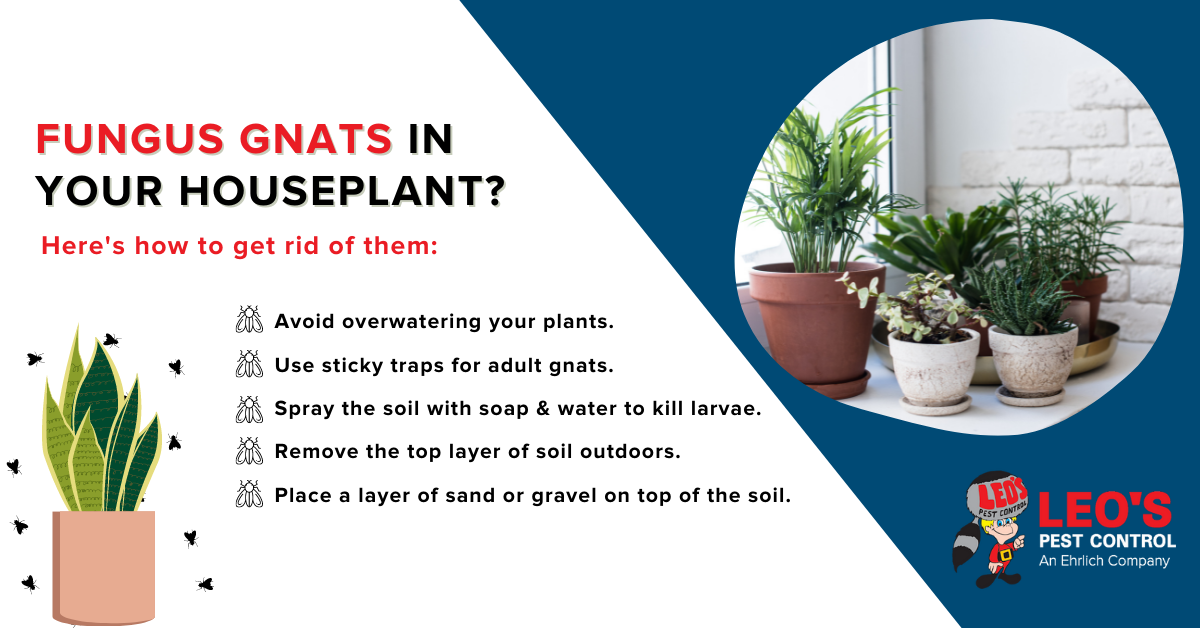
How to get rid of fungus gnats in houseplants - Infographic by Leo's Pest Control

5 Steps to Get Rid of Houseplant Gnats

Keeping gnats away requires knowing how to make your home less attractive to them in the first place. The easiest thing to do is make sure you keep gnats from laying their eggs in the soil of your houseplants. Here’s how:

  1. Never overwater your plants to the point where the soil stays wet for days at a time. You can rake the soil to help it dry quicker.
  2. Avoid letting any water sit in the drainage tray beneath plant pots. Always make sure your houseplants have the best drainage possible by incorporating gravel, sand, and more into your potting soil mix.
  3. Considering “quarantining” the houseplant with the gnats to keep them from spreading. Consider taking it outdoors and removing the top layer of wet soil entirely.
  4. Place sticky traps in the plant soil to target and trap any adult gnats that are already flying around.
  5. To get rid of gnats in your yard, make sure to not overwater your lawn, keep your garbage sealed properly, and make sure you have proper drainage on your roof and elsewhere.

How to Keep Gnats Away For Good

Gnats may be tiny and mostly a nuisance, but they can also spread germs that cause diseases like salmonella or E. coli. For that reason, it’s crucial to keep them away. If you’re having trouble controlling the gnats in your home, the experts at Leo’s Pest Control can help. We can help identify the conditions that are attracting them, and provide you with a plan to keep them away for good. Contact us today!

No-see-ums vs Gnats vs Mosquito Bites—How Are They Different?

A small swarm of gnats in Bristol TN - Leo's Pest Control

No matter the time of day or time of year, bugs in Bristol TN are out and biting. You could be awake or sleeping, outside or inside, and still be a target.

When it comes to staying safe from bug bites, flying pests can be the hardest to defend yourself from. There are multiple kinds of airborne insects in our region that can dish out painful, irritating, or even dangerous bites. In particular, we hear a lot of people complain about no-see-ums, gnats, and mosquitoes. If you think you’ve been bitten by one of these pests but are having trouble identifying your bites, read on for Leo’s Pest Control’s expert insight!

Gnats vs No-see-ums vs Mosquitoes

These three pests are widely felt to be Bristol’s most annoying insects. We’ve all ran into these pests at some point or another, but here’s how to be sure which one you’re seeing:

  1. Mosquitoes: Much larger than our other two friends, mosquitoes can be identified easily. They have long wings and a proboscis that looks like a needle protruding from their mouth. Their bodies form a hunch-backed position and grow to about 3/8”.
  2. Gnats: These tiny flies come out in spring and summer by the thousands. Gnats are very small with gray or black bodies, and they move together in large swarms, or clouds, of individuals.
  3. No-see-ums: No-see-ums are actually a specific type of gnat. They are even smaller than their counterparts, at only around 1/16” in length. This allows them to squeeze through the screens on our windows and doors.

Differences Between Bug Bites

One way to tell apart the kinds of pests around your home in Bristol TN is to be able to identify them by bite symptoms. These are the main differences between mosquito, gnat, and no-see-um bites:

  • Mosquito bites: Mosquito bites start as a raised white welt and recede into a pinkish-red bump. They are likely to take place on your arms, legs, or other easily accessible areas of exposed skin.
  • Gnat bites: Gnat bites look similar to mosquito bites, but can be distinguished by being darker, smaller, and more rough-looking. They also take longer to heal than mosquito bites.
  • No-see-um bites: Given that no-see-ums are actually gnats, their bites are very similar to most other gnats. However, no-see-ums are more likely to bite very close together and on less common areas, like your face.

In short, you can differentiate between these kinds of bites by how close together they are, how dark they are, and how long they last.

Preventing Bug Bites in Bristol TN

Using an insect repellent that is made of up to 20% DEET is one of the most effective methods of preventing bug bites during the summer in Bristol. However, if it isn’t enough to stop the pests around your property, you can rely on professional pest control to help you control your outbreak. At Leo’s Pest Control, we have plenty of experience eliminating all kinds of pest infestations and will conduct comprehensive inspections and repellent efforts to keep your yard pest-free. For a free quote on pest control for mosquitoes, gnats, or no-see-ums, contact us today!